Most students do one of two things:
Both approaches fail.They panic and start everything at once.
They delay and hope final year will be enough.
Placements reward clarity, consistency, and depth — not last-minute effort.
This roadmap is designed for:
- Average students
- Tier 2 / Tier 3 college students
- Students targeting product-based companies
- Students targeting service-based companies
- Anyone who wants structured preparation
What You Must Achieve in 6 Months
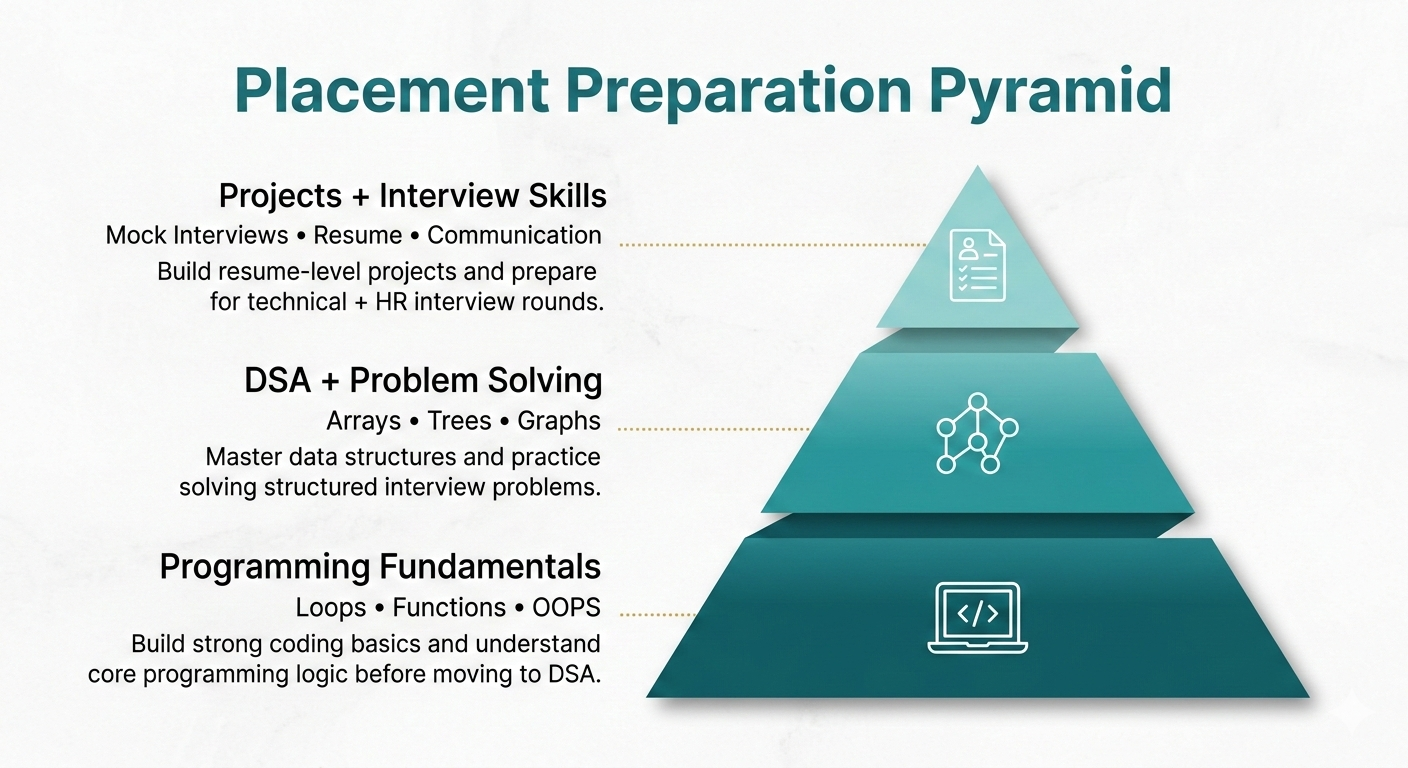
By the end of this roadmap, you should have:- Strong command over one programming language
- Clear understanding of DSA patterns
- 2 solid resume-level projects
- Basic knowledge of core subjects (OOPS, DBMS, OS, CN)
- Experience with mock interviews
- Confidence explaining your work
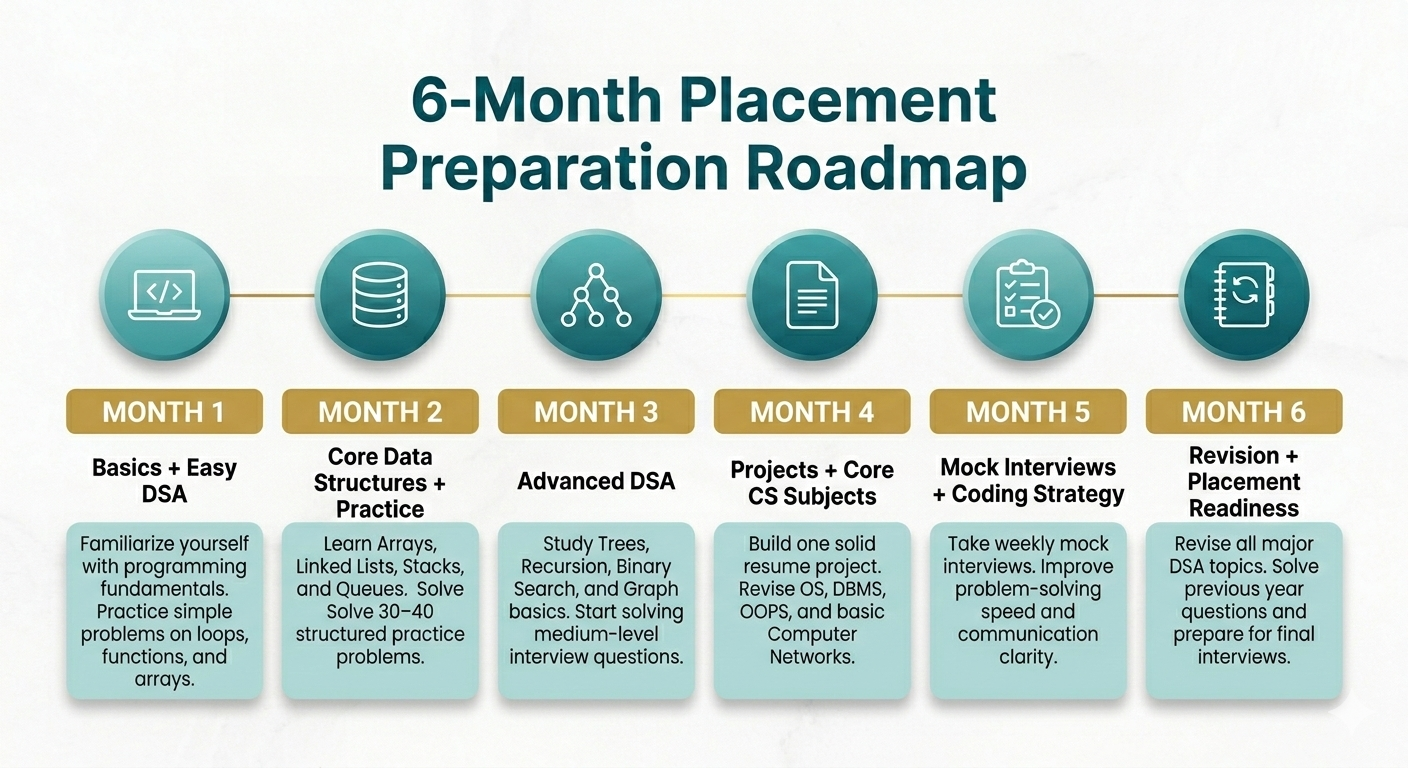
Month 1: Build a Strong Foundation Before You Chase Speed
Month 1 decides whether your preparation becomes smooth or frustrating.Step 1: Choose One Programming Language — and CommitIf your basics are weak, advanced DSA will feel impossible.
If your basics are strong, everything becomes manageable.
Pick one:
- C++
- Python
- Java
Step 2: Strengthen Core Programming Concepts
Ensure you are comfortable with:
- Loops
- Functions
- Recursion basics
- Arrays
- Strings
- Basic OOPS
If you cannot write clean logic without help, DSA will feel difficult later. Spend 2–3 weeks strengthening this layer.Write small programs yourself.
Do not only watch videos.
Step 3: Start with Arrays and Strings
Most coding interviews begin with array-based logic.
Focus on:
- Traversal
- Frequency counting
- Two pointer approach
- Basic prefix sums
By the end of Month 1, you should feel consistent and not overwhelmed.Target: 40–50 quality problems in Month 1.
Month 2: Core Data Structures — Build Pattern Familiarity
Month 2 is about exposure to standard interview structures. Focus on:- Linked List
- Stack
- Queue
- Time and Space Complexity
Example:
That shift happens only through practice. Solve around 70–80 structured problems this month. Do not jump randomly between topics. Complete one structure properly before moving ahead.“This looks like a stack problem.”
“This can be solved using two pointers.”
Month 3: Move to Advanced Patterns + Start Project 1
This is where preparation becomes serious. Now focus on:- Binary Search and its variations
- Sliding Window
- Trees (basic traversal and properties)
- Introduction to Graphs
Recruiters look at:At the same time, start building your first resume-level project.
Why now?
Because placements are not only about DSA.
- Projects
- GitHub activity
- Practical exposure
Choose something practical but manageable:
- Expense Tracker
- Student Management System
- Basic Web App
- CRUD-based application
- Code must be on GitHub
- Proper README
- Clean folder structure
Month 4: Strengthen Profile + Prepare for Interviews
By now, your DSA base should be stable. Month 4 shifts focus toward profile strength.Build Project 2 (Stronger Than Project 1)
Choose something slightly more advanced:
- Full-stack application
- Data analysis project
- AI-based small tool
- Authentication-based web app
Start Core Subject Revision
Many students ignore this. But companies often ask:
- OOPS concepts
- DBMS basics (normalization, joins)
- Operating Systems (process vs thread)
- Computer Networks (HTTP, TCP/IP basics)
Start Structured Interview Preparation
Prepare answers for:
- Tell me about yourself
- Explain your project
- Why should we hire you?
Month 5: Simulation Mode — Practice Under Pressure
This month is about real-world simulation.Mock Interviews
At least:
- 1 technical mock per week
- 1 HR mock every 2 weeks
Timed Coding Practice
Solve problems in:
- 30–45 minutes
- Without hints
- Without immediately checking solutions
Start Off-Campus Applications
Do not depend only on campus. Start:
- LinkedIn networking
- Cold emails to startups
- Applying via company career pages
Month 6: Refinement, Not Expansion
This is the biggest mistake zone. Students often start new topics in Month 6. Do not do that.This month is for:
- Revising important patterns
- Strengthening weak areas
- Reviewing your projects
- Practicing explanations
- Explain your logic step-by-step
- Discuss time complexity
- Handle follow-up questions confidently
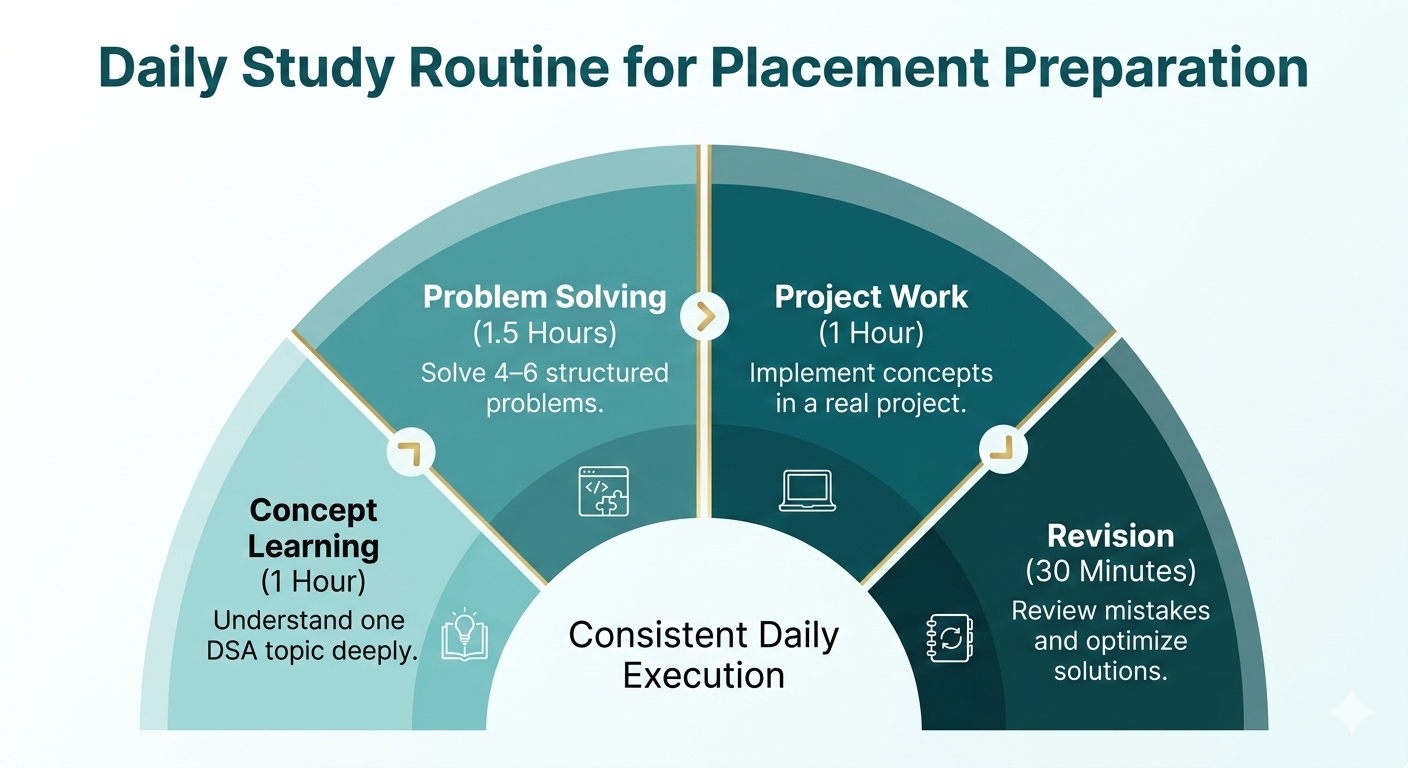
Simple Daily Study Structure
Minimum: 3–4 hours daily. Suggested format:- 1 hour – Concept learning
- 1.5 hours – Problem solving
- 1 hour – Project or revision
Common Mistakes That Ruin Placement Preparation
Here are some common mistakes:- Switching languages repeatedly
- Jumping to hard problems too early
- Ignoring projects
- Ignoring core subjects
- Not doing mock interviews
- Waiting for final year
Conclusion
Placements are not about being extraordinary. They are about being reliable.Companies want candidates who:
- Think clearly
- Write structured code
- Understand fundamentals
- Communicate confidently
Start today.
Consistency will compound.

0 Comments